CVSM Faculty Completes USDA Faculty Exchange Program at UC Davis, USA
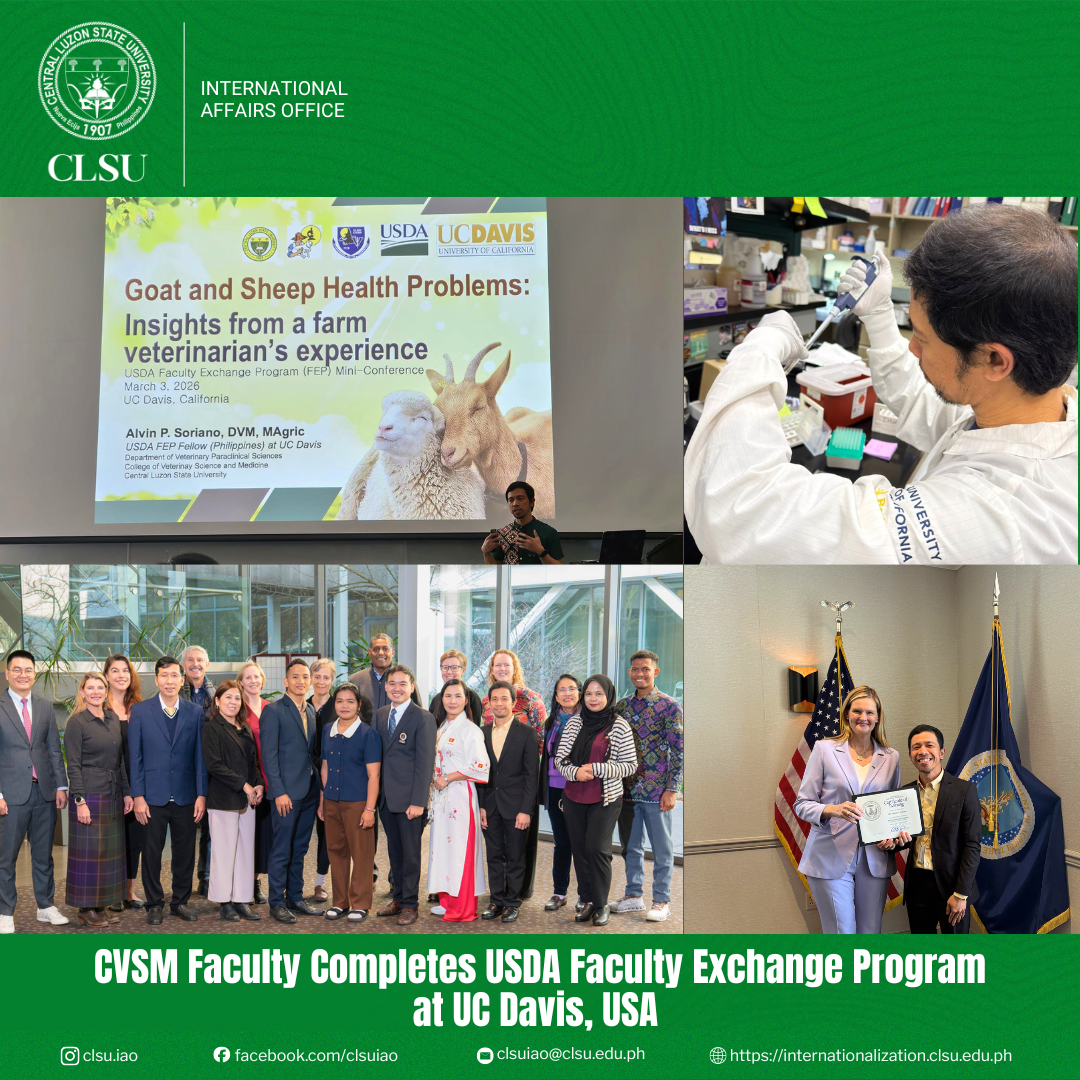
Dr. Alvin Soriano, a faculty member from the College of Veterinary Medicine (CVM) at Central Luzon State University (CLSU), has completed his faculty exchange program at the University of California, Davis, USA, under the USDA Faculty Exchange Program, where he gained advanced exposure to veterinary diagnostics, teaching innovations, and international research collaboration.
During his time at UC Davis, Dr. Soriano immersed himself in hands-on diagnostic work at the California Animal Health and Food Safety (CAHFS) Laboratory. His training included performing necropsies, analyzing tissue slides, and conducting immunological assays such as Enzyme-Linked Immunosorbent Assay (ELISA), which is widely used in disease detection and veterinary diagnostics.
Beyond the technical training, Dr. Soriano also observed innovative teaching methods, particularly Problem-Based Learning (PBL) and Case-Based Learning (CBL). These approaches, he shared, strengthened his view of veterinary education as a discipline that must encourage critical thinking, active participation, and the application of knowledge to real-world animal health cases.
In an interview with the International Affairs Office (IAO), Dr. Soriano described the program as both professionally enriching and personally transformative. He shared that the fellowship allowed him to connect with fellows of different nationalities, mentors, researchers, students, homestay families, and Filipinos living in Davis. These experiences, he said, deepened his appreciation for collaborative learning across cultures.
As a veterinarian and animal nutritionist who previously worked at the Small Ruminant Center of CLSU, Dr. Soriano also brought to the international stage his knowledge of ruminant health and production systems in the Philippine setting. During the fellows’ mini-conference, he shared his experiences on common diseases affecting goats and sheep, including prevention and control strategies practiced in local livestock systems.
Another area of collaboration that emerged during his fellowship was methane emission mitigation in ruminants. Drawing from his background in animal nutrition, Dr. Soriano took part in conceptualizing possible collaborative research on greenhouse gas emission profiling and mitigation, with emphasis on tropical livestock systems. This direction supports broader discussions on One Health, sustainable livestock production, and climate-responsive animal agriculture.
Following his faculty exchange program, Dr. Soriano hopes to strengthen veterinary pathology instruction at CLSU by enhancing necropsy and histopathology discussions, incorporating immunological assays such as ELISA into laboratory activities, and updating lecture materials with teaching strategies he observed at UC Davis. He also plans to explore possible virtual guest lectures and speakerships with mentors and fellow participants of the program.
Dr. Soriano also expressed interest in helping develop a tissue processing and histopathology facility at the Center for Transboundary Animal Diseases (CenTrAD). He said the facility could serve academic and diagnostic purposes, supporting teaching, research, and extension services for stakeholders in the livestock industry.
To faculty, students, and young researchers who aspire to join international programs, Dr. Soriano emphasized that such opportunities go beyond learning new knowledge and skills. He shared that international programs also broaden perspectives, build lifelong professional networks, and allow participants to represent the Philippines on the global stage.
“Every international opportunity is not only a chance for personal growth but also an opportunity to bring back new ideas, strengthen our institution, and help improve the lives of the communities we serve through veterinary science and medicine,” Dr. Soriano shared.