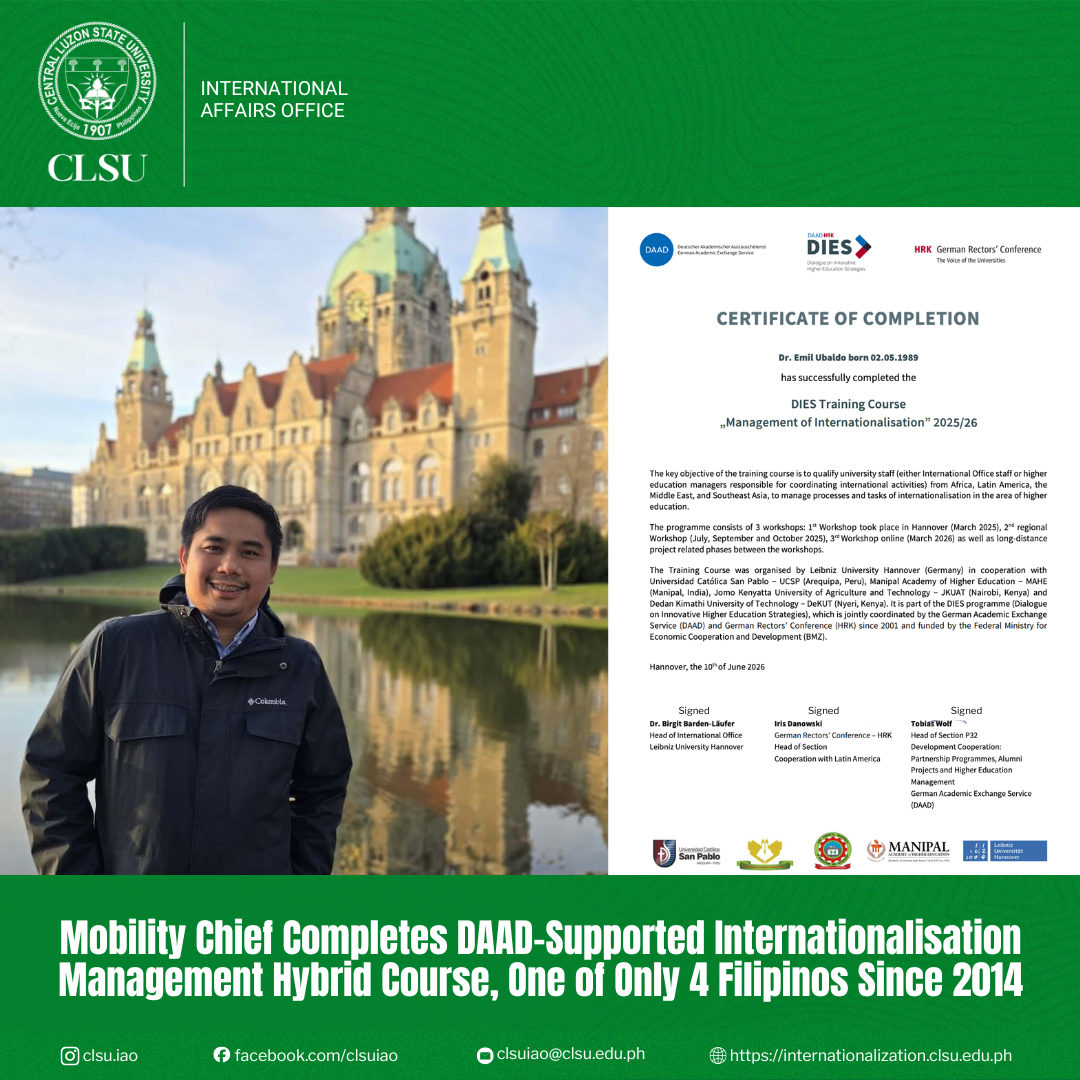
Dr. Emil F. Ubaldo, Chief of the Mobility and Intercultural Exchange Unit of the International Affairs Office (IAO), recently completed the Dialogue on Innovative Higher Education Strategies (DIES) Training Course on Management of Internationalisation 2025–2026.
The 18-month hybrid program was jointly organized by Leibniz Universität Hannover, the German Rectors' Conference (HRK), and the German Academic Exchange Service (DAAD), with financial support from Germany's Federal Ministry for Economic Cooperation and Development (BMZ).
Selected from over 160 applicants across Asia, Africa, and Latin America, Dr. Ubaldo was one of 30 internationalization leaders chosen for the 2025–2026 cohort, with 10 participants representing each region, including 10 from Asia alongside representatives from Vietnam, Indonesia, Thailand, Cambodia, and India.
He is one of only four Filipinos to have been selected for and to have completed the DIES Management of Internationalisation program since its inception in 2014.
Dr. Ubaldo's journey through the program began online in late 2024, before the cohort gathered onsite for the first time at Leibniz Universität Hannover in Germany, from March 10 to 19, 2025. During the Germany phase, he had the opportunity to visit DAAD headquarters, meet with representatives from German higher education institutions, and take part in a cultural immersion in the cities of Cologne and Bonn.
From October 13 to 17, 2025, he participated in the Asia Group regional session hosted by the Manipal Academy of Higher Education (MAHE) in Karnataka, India. Beyond the strategic sessions, the itinerary featured curated cultural exchanges, offering attendees a deeper look into the unique arts, history, and traditions native to the state of Karnataka.
Throughout the program, Dr. Ubaldo and his fellow participants engaged with a curriculum spanning four thematic modules: the concepts and strategy of internationalisation, the core competencies and tasks of an International Office such as academic mobility and partnership building, soft skills such as intercultural communication and conflict management, and management skills in project and change management. Alongside these modules, each participant developed an individual internationalisation project tailored to their institution's specific goals, receiving continuous guidance from program mentors throughout the learning process.
He completed the formal workshops online in March 2026 and saw the program through to its extended close in May 2026. For his own internationalisation project, Dr. Ubaldo worked on harmonizing the policies and procedures of CLSU's outbound student mobility programs, incorporating feedback from previous participants and developing a transfer credit system aligned with prevailing standards.
The DIES Training Course on Management of Internationalisation has, since 2014, supported higher education professionals across the Global South in strengthening institutional internationalisation efforts, with a cohort of 30 individuals selected periodically from universities in Asia, Africa, and Latin America. International office staff and higher education managers interested in future opportunities are encouraged to watch for upcoming DIES calls for applications, which typically require at least two years of experience coordinating international activities, strong English proficiency, and the backing of their institution's top management.